A Visual Exploration of the Personalities in
Hammie and the Moken’s Magic Potion
Note: While we don’t expect our youngest readers to fully grasp these visuals and explanations, we hope they’ll begin to appreciate how images and graphs can represent information in creative ways. Maybe the adults among us can help explain some of these to them — it’s a fun introduction to the world of visual storytelling and how research findings can be brought to life.
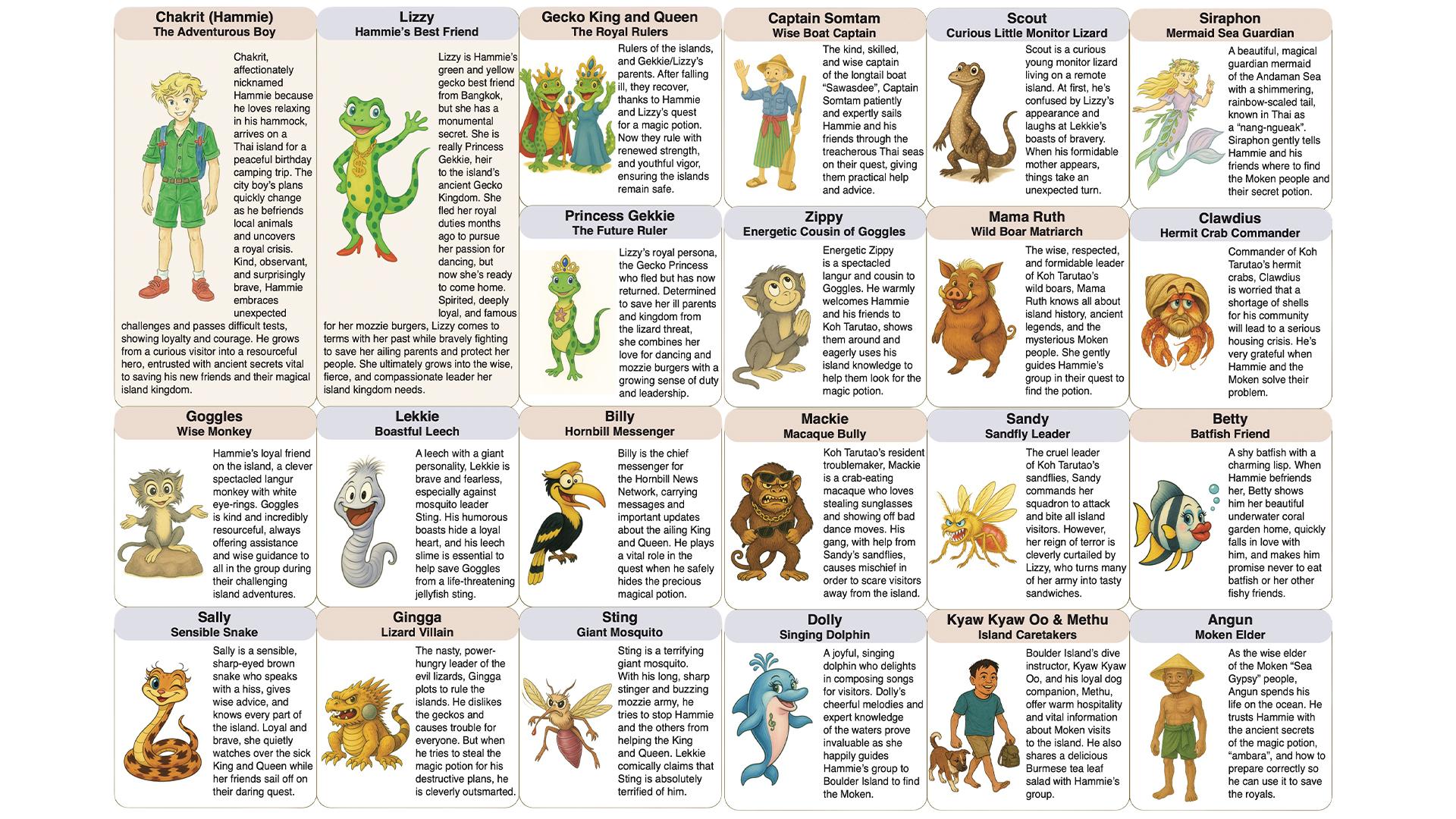
While our full character profiles are available in detail on another page, we know that some readers prefer to see rather than read. So we’ve created this rich visualisation hub — a collection of colourful charts and character maps that bring our island cast to life in a more intuitive way.
Here, we delve into the psychology behind the personalities, relationships, emotional arcs, strengths, and story roles of ten key characters from Hammie and the Moken’s Magic Potion. Why only ten? With twenty-seven vibrant characters in the full story, including everyone in this analysis would make the charts too cluttered to be useful. Instead, we’ve chosen a representative selection that captures the heart, humour, and complexity of the tale.
Scroll down, explore the visuals, and discover new layers to your favourite characters. Whether you’re a parent, a curious young reader, or simply a lover of good storytelling, this is where you’ll gain a deeper appreciation and understanding of each unique identity and the ways they connect.
Character Trait Maps
How to read this Chart:
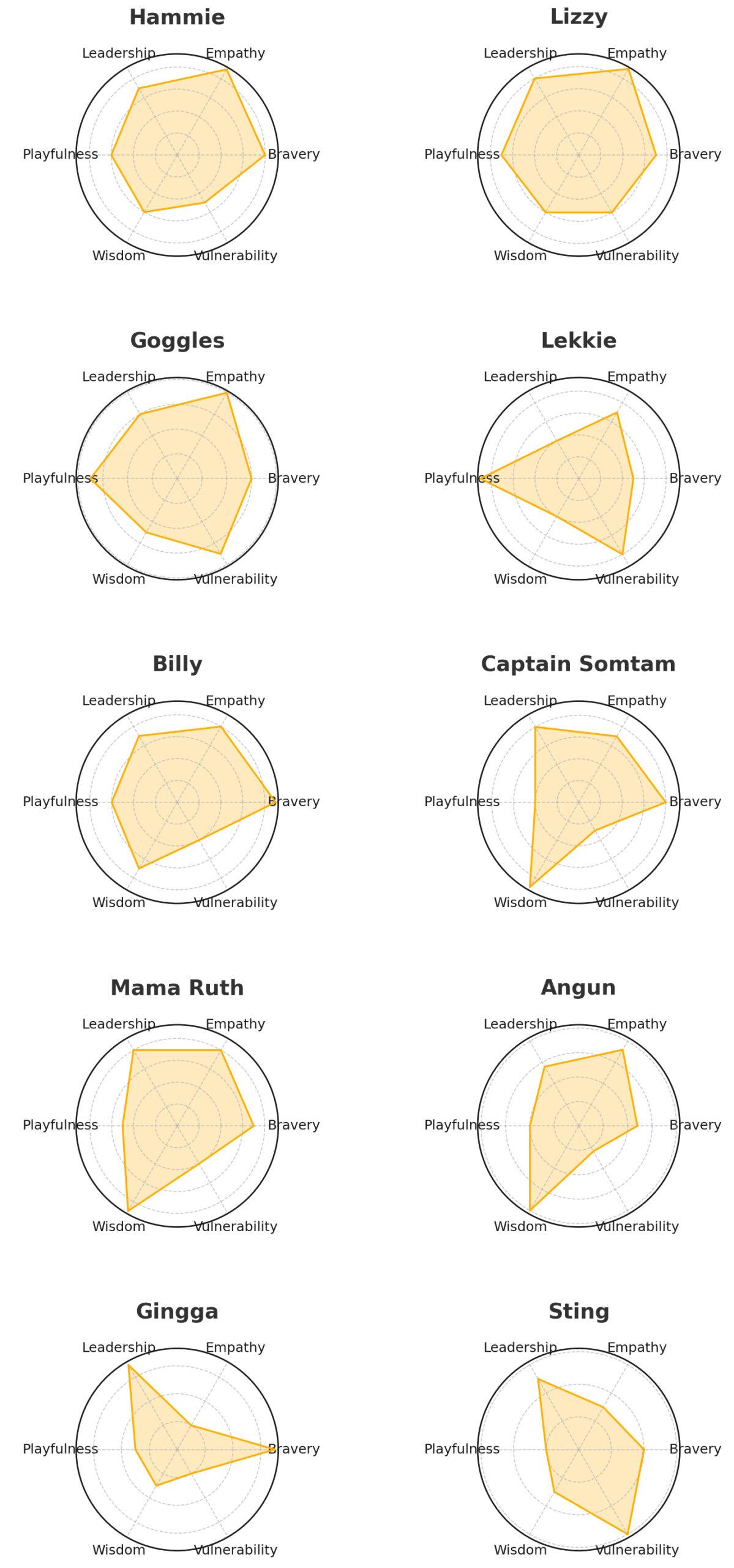
Each chart in this visual represents one character from the book: Hammie and the Moken’s Magic Potion. The shapes you see are trait maps (also called radar- or spiderweb charts), which show how strongly a character expresses six core personality traits:
- Bravery
- Empathy
- Leadership
- Playfulness
- Wisdom
- Vulnerability
Each axis extends from the centre (low) to the outer edge (high) of the spiderweb. The more a trait pushes out toward the edge, the stronger that trait is in that character. So a wide, filled shape shows a character with a broader mix of strong traits, while a more irregular shape highlights imbalances, extremes, or unique strengths.
These simplified spiderweb charts help us to quickly compare personalities and spot patterns, for example, who’s more empathetic, who’s a natural leader, or who hides their vulnerability.
Remember that we have included just 10 of the 27 characters in the book to keep things clean and easy to understand.
To explain, lets look at Lekkie’s chart below. Lekkie’s chart shows a very distinctive profile, with sharp contrasts across the traits:
- Playfulness (Very High): Lekkie scores the highest possible in Playfulness. This aligns perfectly with his cheeky, mischief-loving nature. He jokes, teases, and keeps things unpredictable — his role often lightens tense moments or adds energy to the group.
- Vulnerability (High): His strong vulnerability score shows he’s emotionally open — perhaps more sensitive than he lets on. Despite the jokes and bravado, Lekkie has moments of self-doubt or fear, which make him more relatable and human.
- Empathy (Moderate to High): He shows a decent level of empathy. Lekkie may tease others, but he understands feelings and steps up to support friends when needed. He’s not cold — just expressive in a playful way.
- Leadership (Low): This is one of his lowest traits. Lekkie doesn’t naturally take the lead or plan ahead — he follows, disrupts, or questions authority rather than guiding others. He’s more the wild card than the captain.
- Wisdom (Low): His low wisdom score highlights his impulsiveness and occasional poor judgement. He acts on instinct, not reflection. That’s part of his charm — and his risk.
- Bravery (Moderate). Lekkie isn’t a coward, but he’s not the bravest either. He’ll stand up in certain situations, especially for his friends, but may hesitate when things get too serious or dangerous. He talks a big game — always boasting about daring feats and pretending nothing scares him — but much of it is bluff. Deep down, he’s quite insecure and often overcompensates with bravado. While he does rise to the occasion at times, his courage is still developing, and his loud confidence often masks a quieter vulnerability he rarely shows.
IN SUMMARY:
Lekkie is the chaotic spark in the group — mischievous, emotionally open, and often reckless, but full of heart. His high playfulness and vulnerability, combined with his bluffing bravado and lack of caution, make him the lovable rascal: unpredictable, loud, and occasionally foolish — yet deeply loyal when it counts.
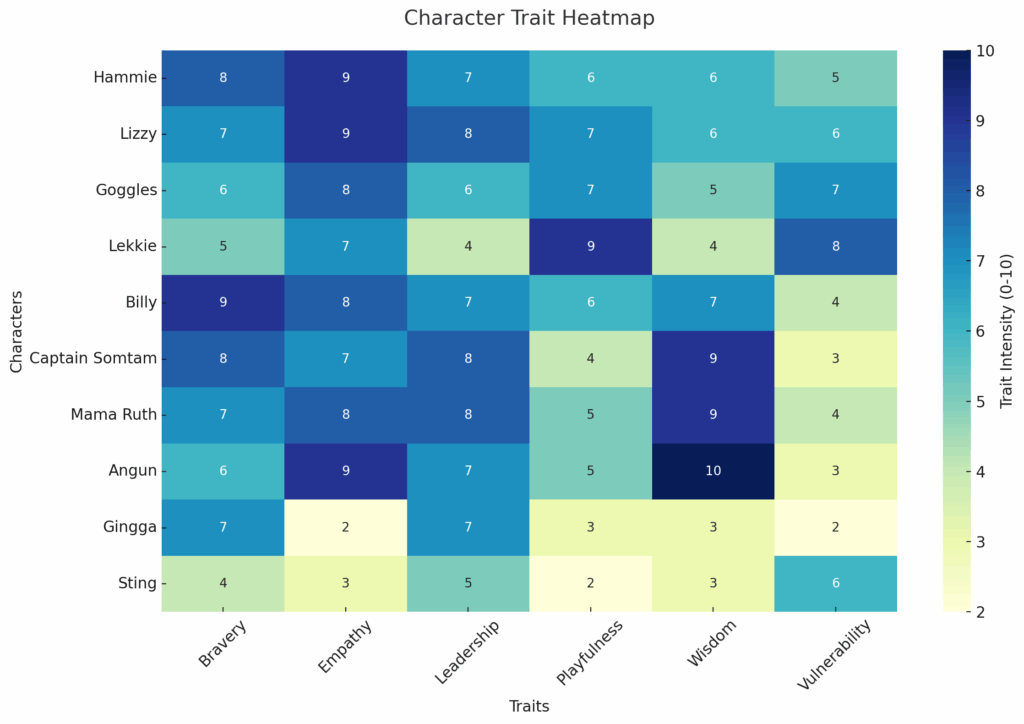
Here is an alternative way to look at the above information: This is called a heatmap.
How to read this heatmap:
Each row represents a character, and each column shows a personality trait — from Bravery to Vulnerability. The numbers inside the boxes show how strongly that character expresses the trait, on a scale from 0 (very low) to 10 (very high).
The darker the blue, the higher the score. So, for example, Hammie scores high in Empathy (9) and Bravery (8), while Gingga has very low Empathy (2). It’s a quick visual way to compare personalities at a glance!
Thematic Contribution Wheel
How to read this Chart:
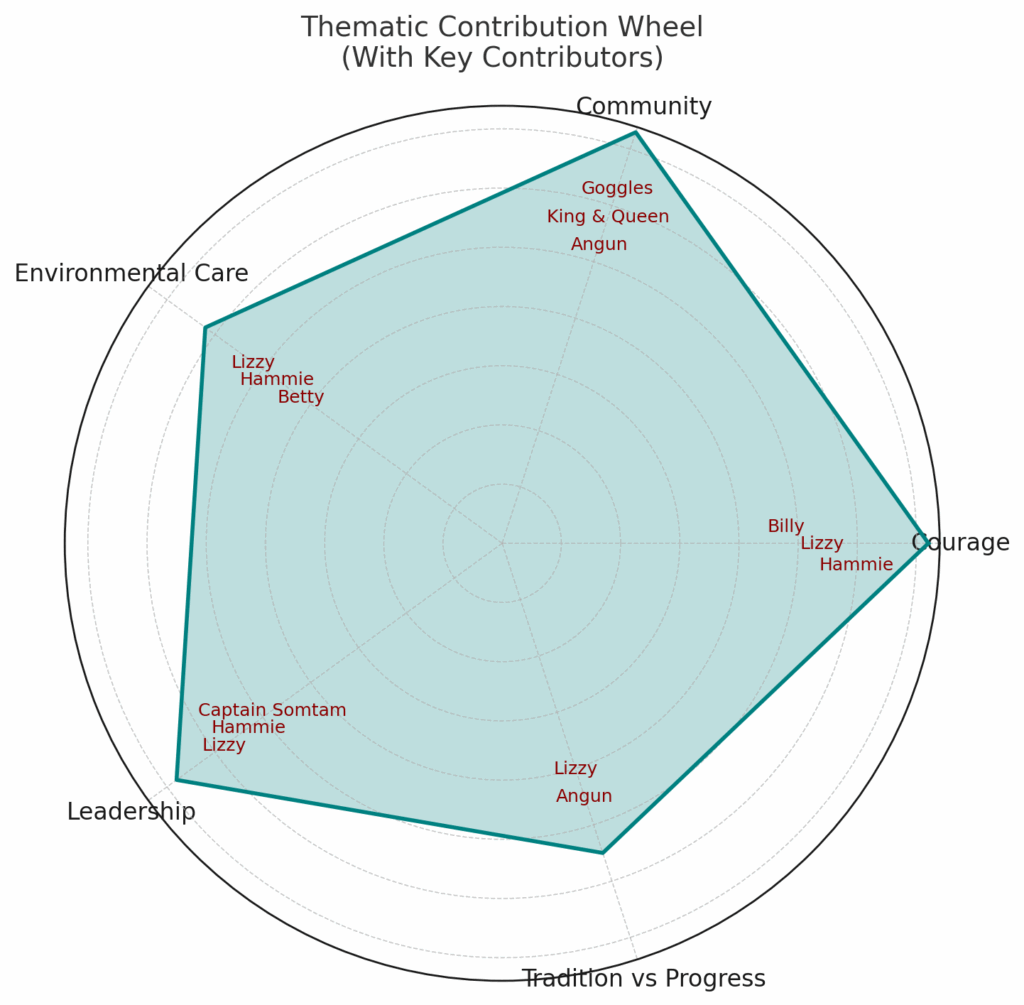
Here we have another “spiderweb-style” chart that shows how strongly the story supports each major theme — like Courage, Community, and Environmental Care. The further out the teal shape stretches in a direction, the more that theme is emphasised in the story.
- The five axes represent five key themes in our story.
- The coloured area shows overall contribution to each theme on a scale from 0 (centre) to 10 (outer edge).
- Around the edges, you’ll see the names of specific characters who contribute most clearly to each theme.
- For example, Billy, Lizzy, and Hammie are key drivers of Courage.
- Captain Somtam, Hammie, and Lizzy represent Leadership.
- Lizzy and Angun are central to the theme of Tradition vs Progress.
This wheel lets you see at a glance not just what the story is about, but who carries the major messages of the story.
Archetype Mapping
How to read this Chart:
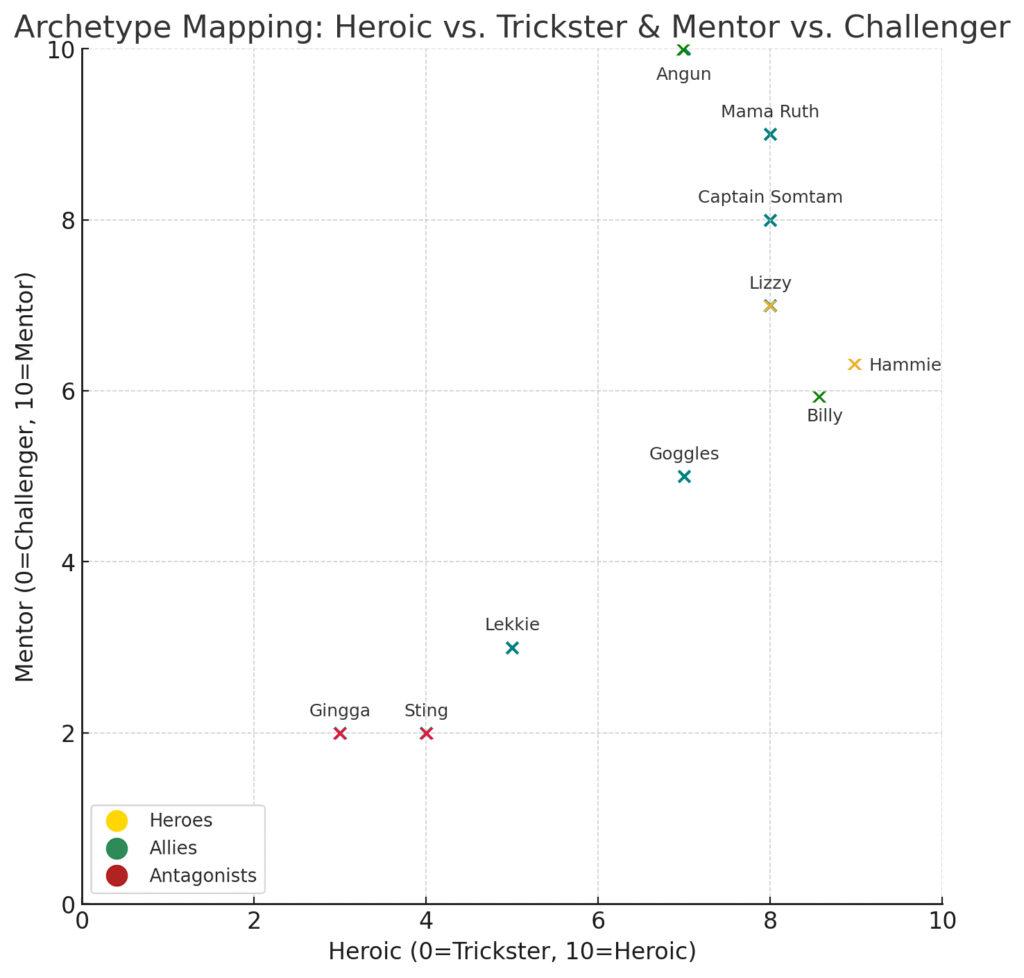
In storytelling, archetypes help us understand characters by identifying the core roles or energies they bring to a story. These aren’t fixed labels but rather guiding patterns — like “The Hero,” “The Trickster,” or “The Mentor.” Archetype maps let us visualise where each character sits along certain spectrums, revealing deeper personality dynamics and how they relate to the themes of the story.
We’ve created two archetype maps to explore these roles in Hammie and the Moken’s Magic Potion:
1. “Heroic vs. Trickster” & “Mentor vs. Challenger“
This chart blends two important archetype spectrums:
- Heroic ↔ Trickster (horizontal axis): Is the character noble and dependable like a hero, or chaotic and unpredictable like a trickster?
- Mentor ↔ Challenger (vertical axis): Does the character support and guide others, or challenge and push them?
For example:
- Mama Ruth and Angun and even Captain Somtam lean strongly toward the Mentor–Heroic side — supportive and wise.
- Hammie falls clearly in the Heroic zone, but only mid-level on the Mentor scale — he’s brave, dependable, and often takes initiative, but he’s still learning how to guide others. While not yet a full mentor, his actions inspire those around him, and he’s on the path to becoming a strong role model.
- Gingga and Sting fall clearly into the Trickster–Challenger quadrant. With low scores on both the Heroic and Mentor axes, they represent disruptive forces in the story. Cheeky, cunning, and unpredictable, they’re often up to mischief — challenging others, sowing confusion, or simply stirring the pot for fun. While they might not be outright bad villains, their actions often test the patience and resolve of the main group.
- If Mackie and Sandy were part of this analysis, Sandy would likely be in a slightly weaker position than both Gingga and Lizzy, while Mackie could be close to Lekkie, though a bit weaker.
Colours show how much a character is connected to the core group:
- 🟡 Heroes – Characters driving the story’s central mission (Hammie & Lizzy).
- 🟢 Allies – Key supporting characters who guide, mentor, or strengthen the group.
- 🔴 Antagonists – Characters who challenge or disrupt the goals of the heroes (Gingga & Sting).
2. Bravery vs. Community Focus
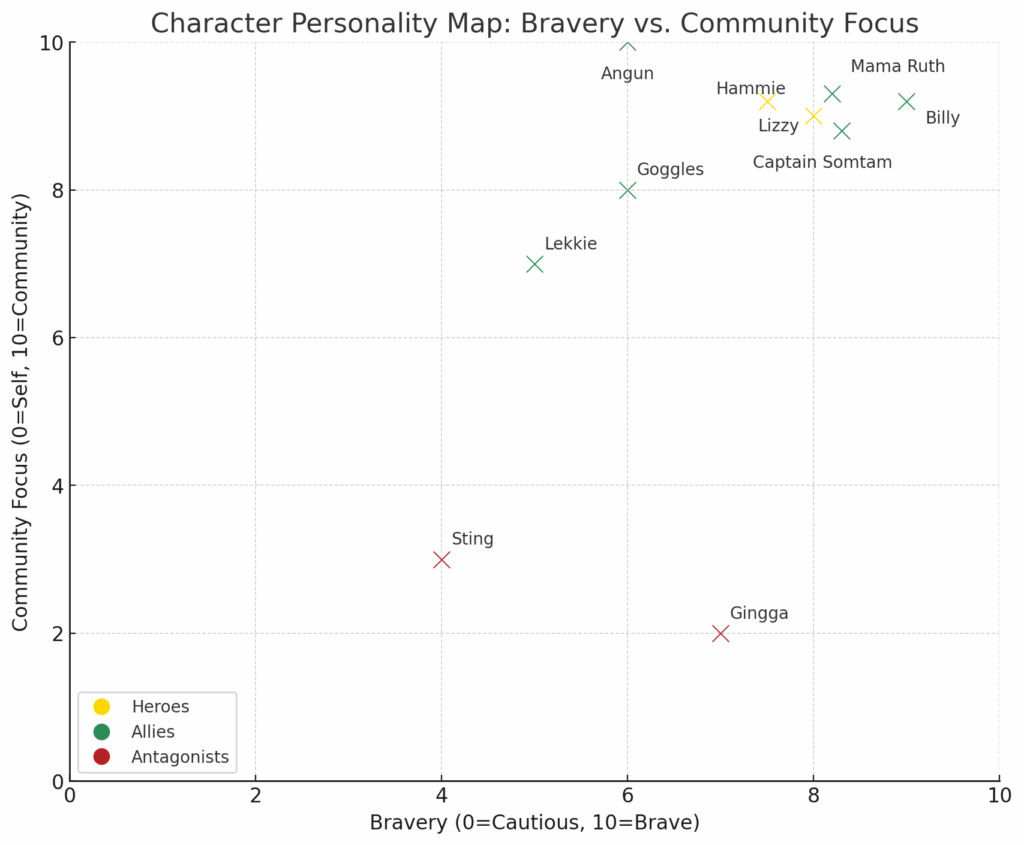
This chart places characters on a grid based on:
- Bravery (vertical axis): How bold or daring a character is.
- Community Focus (horizontal axis): How much they act for the group (community) versus personal goals (self).
For example:
- Billy scores high on both bravery and community focus, which places him toward the top right of the chart. He’s courageous in the face of danger and deeply cares about his friends’ safety, often stepping in to support or guide them. His boldness is matched by a strong sense of responsibility to those around him.
- Lekkie lands almost in the middle of the chart, and that says a lot about his complex personality. He sits midway on the bravery scale, showing he has some courage but isn’t always the first to jump into danger — especially if things get a bit too real. His community focus is slightly above average, meaning he does care about the group and wants to belong, but his actions are sometimes influenced by self-interest or insecurity. He’s a work-in-progress — loyal and eager to help, but still learning when to step up and when to put others first. This position captures a character who’s growing, uncertain, but full of heart.
- Sting lands low on both bravery and community focus — placing him towards the bottom-left quadrant. He’s cautious and easily frightened, especially when Lizzy threatens to turn his mozzies into “mozzie burgers.” Sting rarely takes risks and often acts aloof or self-serving. His lack of bravery makes him easy to rattle — especially by louder personalities like Lekkie, who regularly intimidates him in mozzie language.
- Gingga doesn’t seem to care much for his fellow lizards — he barely even mentions them. While his community focus is very low, his bravery stands out as notably higher than Sting’s. Nothing seems to scare Gingga. He’s bold, confident, and unafraid to push boundaries — even if it means stirring up trouble. Far more assertive and confrontational than Sting, Gingga may be selfish, but he’s certainly not afraid to act.
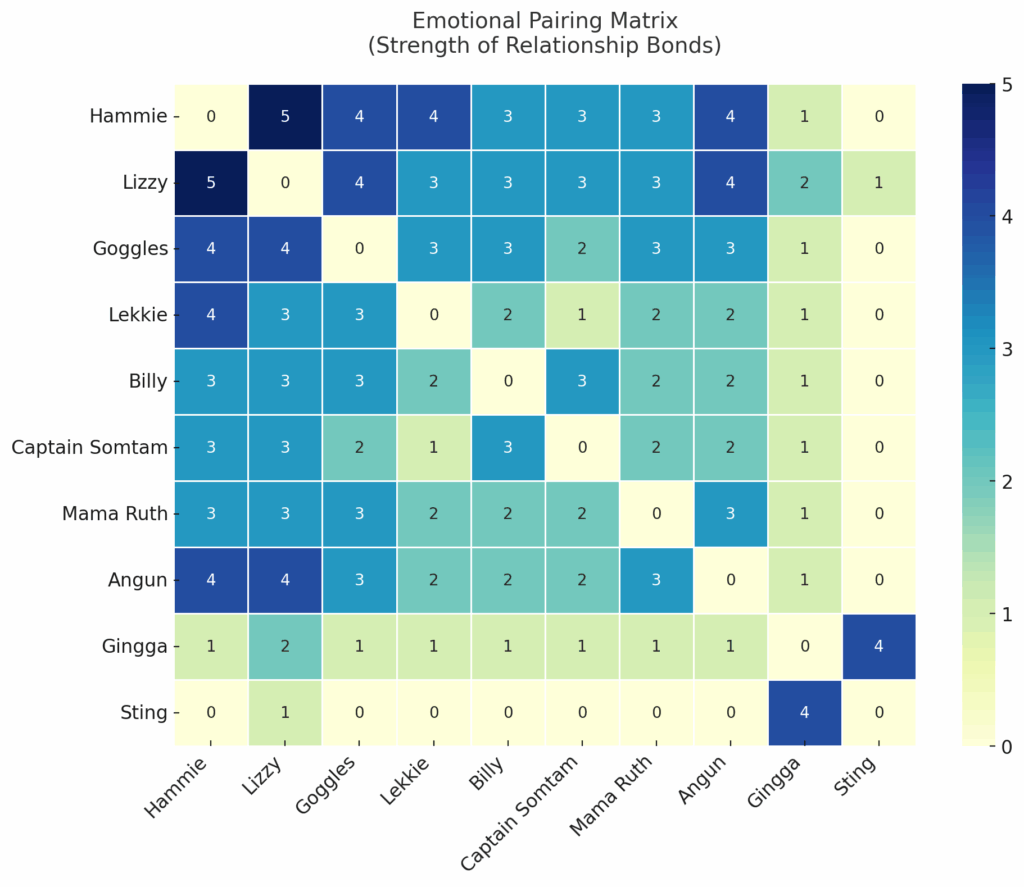
Emotional Pairing Matrix
How to read this Chart:
This chart shows the strength and type of emotional connection between every pair of characters. Think of it as a relationship map — not about romance, but about trust, tension, support, and loyalty.
The Words Inside Each Box
Each square contains a short label describing the nature of the relationship. Some examples:
“Fear-based Alliance” – A connection driven by fear, not trust (e.g. Sting & Gingga).
“Deep bond / Mutual growth” – A very strong and evolving connection (e.g. Hammie & Lizzy).
“Humour & Loyalty” – A light-hearted but committed friendship (e.g. Hammie & Lekkie).
“Respect & Guidance” – A mentor-like relationship (e.g. Captain Somtam & Hammie).
“Antagonistic Tension” – Ongoing conflict or opposition (e.g. Gingga with almost everyone).
Reading Rows vs Columns
Reading across a row shows how one character feels or interacts with others., e.g. In Lizzy’s row, we see her relationship to everyone else.
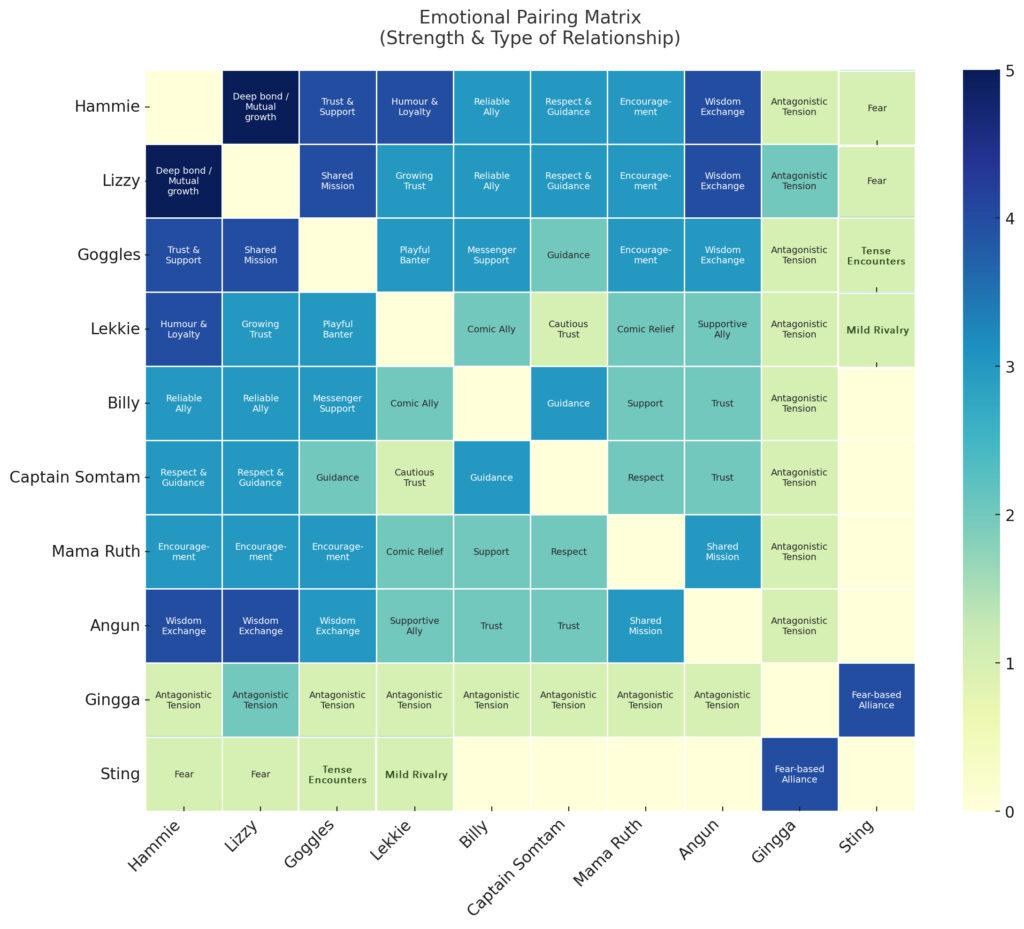
IF too many words confuse you, just look at the numbers below. In this matrix, the numbers represent the strength of each relationship, ranging from 0 (no bond) to 5 (very strong bond) — the higher the number, the deeper or more meaningful the connection between those two characters.
The Numbers (0 to 5)
The colour intensity shows how strong the emotional bond is.
* Darker blue (5) = very strong relationship
* Lighter blue/green (1-4) = weaker connection
* Yellow (0) = no meaningful bond or interaction
That’s it for now. Hopefully you now have a better understanding (and appreciation) of our characters: